
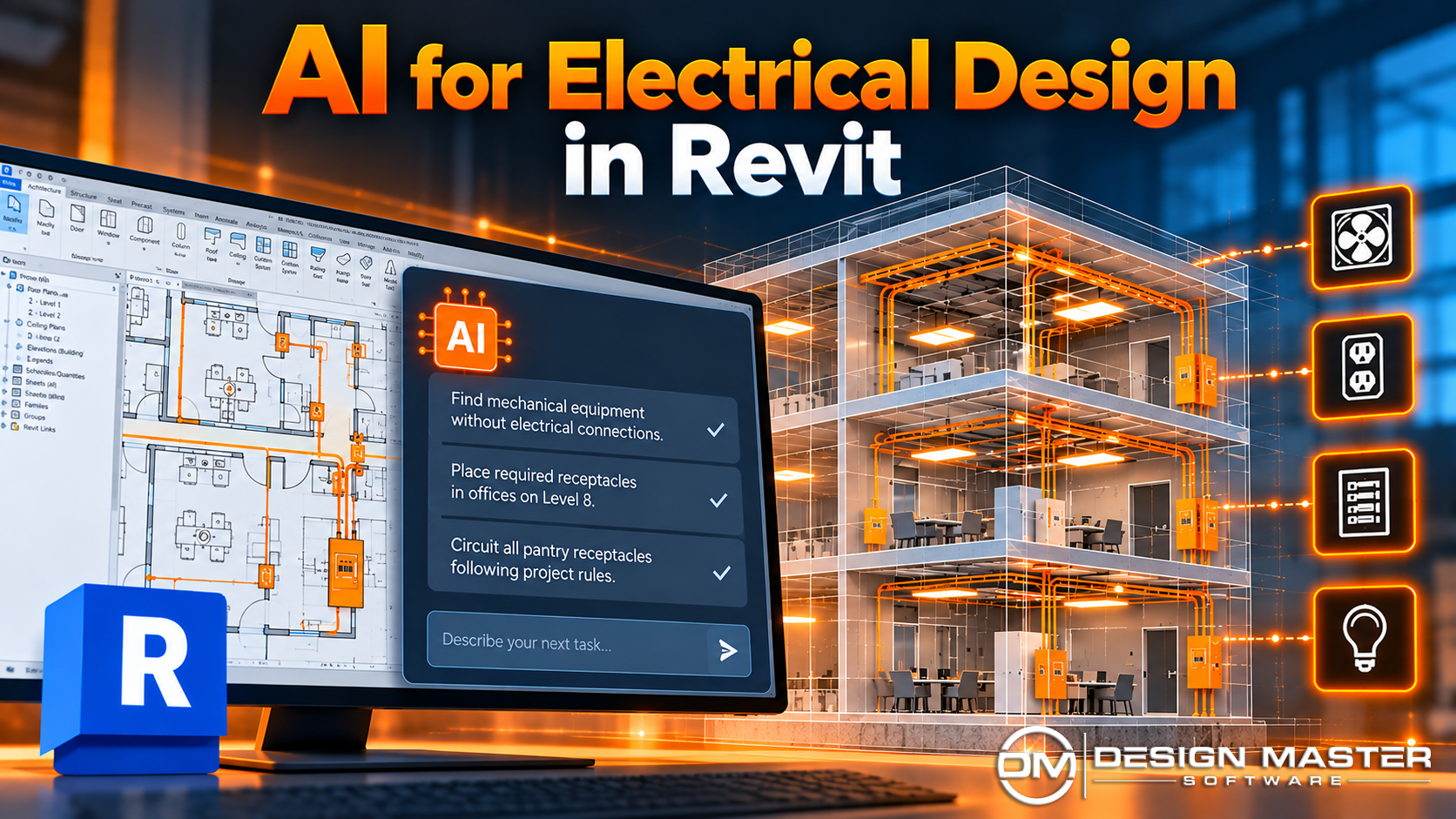
Artificial intelligence is changing how electrical engineers work in Autodesk Revit. Rather than simply answering technical questions or generating recommendations, AI agents can now interact directly with electrical models, identify coordination problems, place devices, create circuits, and apply established engineering standards. For electrical engineers managing complex building projects, this represents a significant development.
Early experiences with ElectroBIM’s Model Context Protocol (MCP) demonstrate how AI can support electrical design workflows on active commercial projects. These applications also reveal important considerations involving model quality, engineering judgment, design standards, and the appropriate division of responsibilities between engineers and AI.
Connecting AI Agents to Electrical Models in Revit
Traditional AI tools generally operate outside engineering design software. They can explain electrical concepts or suggest solutions, but they cannot necessarily inspect or modify a building model. ElectroBIM’s MCP changes that relationship by allowing compatible AI agents to interact with electrical design information directly inside Revit.
Engineers can describe tasks using natural language, and the agent can examine model elements, retrieve information, and execute supported operations. For example, an engineer might ask an agent to identify mechanical equipment without corresponding electrical connections. The agent can examine the model, identify discrepancies, and recommend corrective actions.
Using AI to Resolve Electrical Coordination Problems
Coordination between mechanical and electrical systems is a persistent challenge in commercial building design. Mechanical equipment may be added, relocated, or modified throughout a project’s development, requiring electrical engineers to identify those changes and ensure equipment connections, circuits, and documentation remain accurate.
In one real-world application, an AI agent examined a Revit model and identified fan coil units lacking electrical motor connections. Rather than immediately modifying the design, it reported the missing connections and requested authorization to create them. After receiving approval, the agent examined the equipment’s electrical parameters, including voltage and amperage, and created corresponding motor elements. It also matched motor names to the associated mechanical equipment.
When circuiting the motors, the agent identified an appropriate panel and requested confirmation before proceeding. ElectroBIM then performed its established electrical design functions, including conductor and breaker sizing. This illustrates an important distinction between the two technologies: the AI agent manages the requested workflow, while ElectroBIM performs the specialized electrical calculations.
Automating Receptacle Placement and Electrical Layouts
Commercial office layouts frequently change during design. Workstations move, room configurations evolve, and engineers must repeatedly review receptacle locations. AI agents can help by evaluating rooms against specific placement instructions and identifying where devices need to be added or adjusted.
For example, an engineer can request that every office on a particular floor contain at least three receptacles, including outlets positioned near computer monitors and additional receptacles along suitable walls. In one test, the agent identified six rooms requiring additional devices and placed receptacles according to the specified criteria. It also respected practical modeling constraints. When computer monitors were positioned away from walls, the agent-maintained wall-hosted receptacle placement rather than positioning devices in open space.
However, automation is not equally efficient for every task. Moving one receptacle manually may be faster than instructing an AI agent to do it. The greatest potential time savings come from repetitive tasks involving numerous rooms, devices, or model elements, where the agent can evaluate and implement changes across a larger portion of the project.
AI Circuiting in Revit Using Design Rules
Circuiting is emerging as one of the more compelling applications of AI-assisted electrical design. Electrical engineers follow detailed requirements governing circuit assignments, breaker selection, circuit descriptions, and dedicated equipment connections. These requirements can be communicated to an AI agent through predefined design instructions, sometimes called a playbook.
Consider a commercial building containing multiple pantry areas. An engineer might establish rules requiring ground-fault protection for receptacles within a specified distance of sinks, dedicated circuits for refrigerators and other designated equipment, consistent circuit naming conventions, and circuit assignments that follow project standards. With those rules established, the engineer can issue a simple instruction: “Circuit all the receptacles in the pantry on the eighth floor.”
In an actual project test, the AI agent completed this assignment, applying predefined rules, updating circuit descriptions, and assigning ground-fault protection where required. The significance extends beyond simply creating circuits. A natural-language instruction can initiate a multi-step electrical design workflow governed by established engineering requirements.
Standardizing Electrical Design Through AI Playbooks
One broader implication of AI-assisted electrical design involves consistency across engineering teams. Engineering firms maintain design standards, but individual engineers may interpret or implement those standards differently. Preferences concerning circuit organization, equipment connections, and device placement can vary between projects and personnel, making standardization an ongoing challenge.
AI playbooks offer a mechanism for applying these rules more consistently. A firm could develop shared instructions covering common electrical design requirements, then customize them for specific building types or clients. Separate playbooks might address hospitals, schools, and commercial offices, each containing rules governing circuiting, device placement, naming conventions, and other recurring design decisions. Engineers would still establish and validate the standards, but AI agents could help execute them consistently across projects.
Understanding the Limitations of AI in Revit
Despite these capabilities, AI-assisted electrical design has limitations. An agent’s effectiveness depends heavily on the information available within the Revit model. For example, an engineer might ask an agent to identify every building exit requiring an exit sign. If the architectural model does not distinguish egress doors from other doors, the agent may lack the information necessary to complete the task reliably.
Similarly, spaces without meaningful room classifications may be difficult to evaluate against electrical design requirements. Engineers can sometimes address these limitations by supplying additional context, such as identifying a room as a pantry or kitchenette. AI agents may also encounter limitations involving Revit families or supported operations. In one test, an agent initially struggled to duplicate a family type but subsequently identified an alternative method.
The Future of AI-Assisted Electrical Design
Modern building projects undergo continuous revisions. Architects modify layouts, mechanical engineers relocate equipment, and clients request changes throughout design development. Identifying the consequences of those changes can require considerable engineering effort, particularly when multiple disciplines are working within interconnected models.
AI agents introduce the possibility of routinely examining model information, identifying discrepancies, and helping engineers determine what needs attention. Instead of manually reviewing every potential coordination issue, an engineer could ask the agent to inspect the model and identify elements requiring updates.
Early applications of ElectroBIM MCP suggest that AI-assisted electrical design is already becoming a practical tool for commercial building projects. The technology continues to develop, and its effectiveness depends on well-structured models, clearly defined instructions, and appropriate oversight. To see how AI can improve your electrical design workflow in Revit, download the free ElectroBIM trial to explore AI-assisted circuiting, equipment coordination, and other design automation capabilities firsthand. You can also sign up for our free webinar to see ElectroBIM in action.