
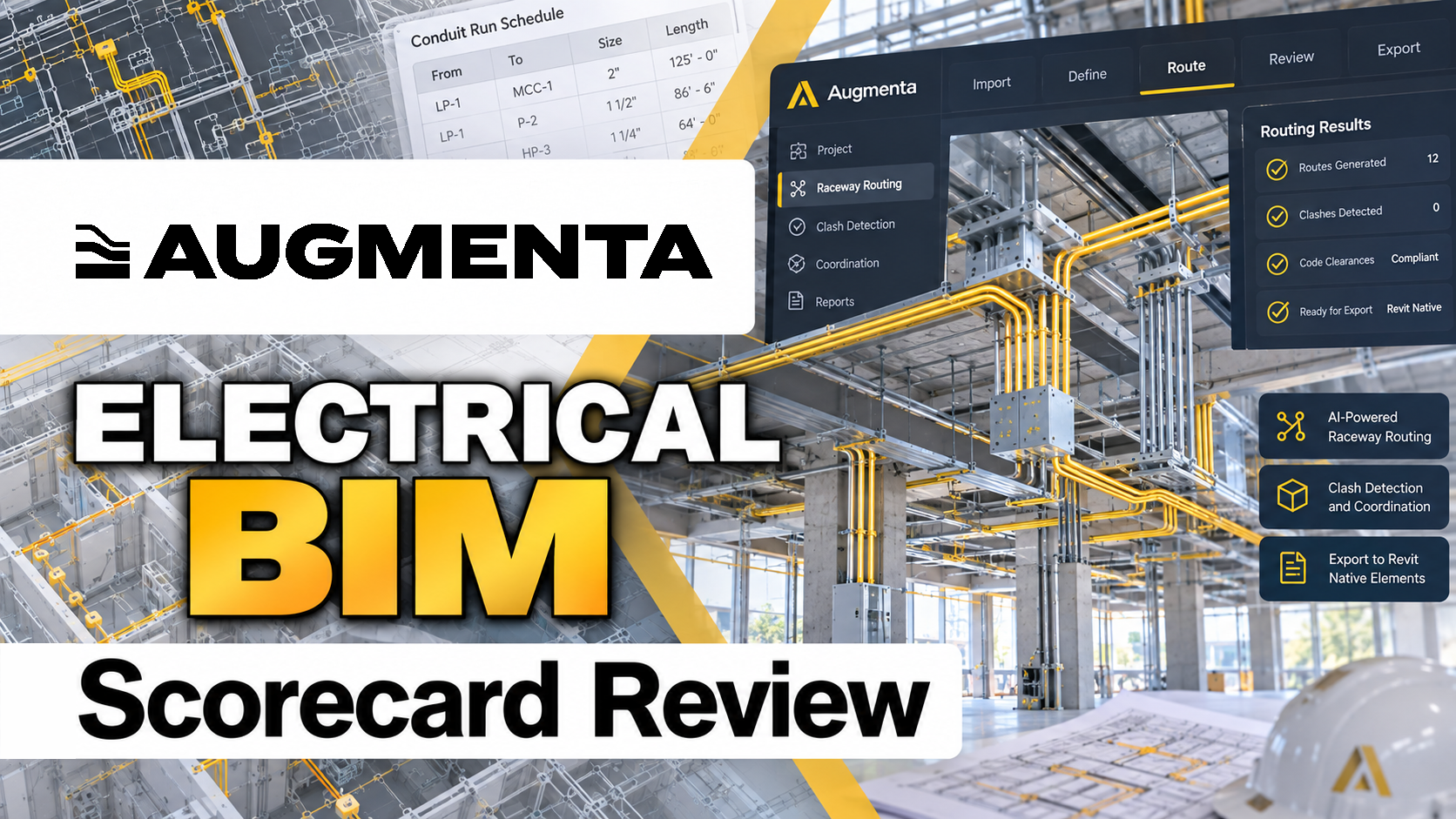
Augmenta is an impressive AI platform for electrical construction. It can automate the routing of large quantities of conduit, identify clashes, generate coordinated 3D raceway models, and help electrical contractors move projects toward prefabrication faster.
Those are valuable capabilities. They are not, however, the same as electrical engineering design.
This distinction is easy to miss because Augmenta uses terms such as “autonomous building design,” “electrical design,” and “AI-powered design.” The product works with electrical systems and produces detailed electrical models, but its primary users are electrical contractors and their BIM and virtual design and construction teams. It starts with design information that has already been established and focuses on turning that information into coordinated, constructible raceway layouts.
To understand where Augmenta fits, we evaluated it using the Electrical Engineering BIM Scorecard. The scorecard asks ten yes-or-no questions about the engineering functions electrical designers need from BIM software. It intentionally looks beyond visible 3D geometry to the calculations, system relationships, and documentation at the center of electrical engineering.
Based on Augmenta’s current public materials, its score is 2 out of 10.
That low score is not a judgment that Augmenta is poor software. It shows that the product is built to solve a different problem for a different audience.
What Does Augmenta Do?
The company’s current electrical product is the Augmenta Construction Platform, or ACP. According to the Augmenta electrical product page, ACP uses Spatial AI to automate electrical raceway modeling for BIM and VDC teams.
The workflow begins by importing an existing model and conduit run schedule from Revit. Users define the “to” and “from” locations, preferred routing areas, no-fly zones, clearances, spacing, minimum raceway heights, and other project specifications. ACP then generates routes that account for building geometry and potential clashes.
Users can compare alternatives, steer routes, edit the result, reroute affected areas, and coordinate against structural, mechanical, and plumbing models. Once the raceway system is ready, the conduit is exported to Revit as native model elements. Contractors can then perform quality control and prepare the coordinated model for construction and prefabrication.
ACP 2.0 supports overhead, underground, and in-slab conduit. It routes feeders and branch systems, performs real-time clash detection, and works with existing Revit families and downstream contractor tools. Augmenta describes the product as “contractor-grade,” and its published case studies focus on reductions in modeling time, faster coordination, less material waste, and getting fabrication-ready drawings to the shop sooner.
This is sophisticated work, particularly on conduit-heavy projects such as data centers, hospitals, schools, and large commercial buildings. Raceway routing can require hundreds of hours of manual modeling and repeated coordination with other trades. Automating that effort can be enormously useful to a contractor.
The important point for this review is where the workflow starts. Augmenta says users define source and destination points using an existing conduit run schedule. One of its case studies describes the division of responsibilities even more clearly: engineers place source and destination points, and the VDC team handles the conduit routing, clashes, and preparation of the model for prefabrication.
In other words, ACP consumes an electrical design and develops its constructible physical routing. It does not create the underlying engineering design measured by this scorecard.
Scoring Augmenta
1. Does engineering exist? Yes.
Augmenta acknowledges engineers as participants in the project workflow. Its product materials describe modelers, engineers, and field teams contributing routing preferences and project specifications. The company also positions ACP within the broader building design process.
This earns the first point. However, engineers are not the product’s primary audience. ACP 2.0 is repeatedly described as a platform for electrical contractors, BIM teams, VDC teams, preconstruction teams, and field personnel.
2. Does MEP exist? Yes.
Augmenta explicitly addresses MEP coordination. Its electrical routing engine evaluates conduit against architectural, structural, mechanical, and plumbing geometry, while mechanical and plumbing automation are identified as future product areas.
The platform clearly understands the multi-trade construction environment, so it earns the second point.
3. Does electrical engineering exist? No.
Electrical systems certainly exist in Augmenta. Electrical engineering, in the sense intended by the scorecard, does not.
ACP focuses on raceway modeling, routing, clash detection, coordination, constructibility, and fabrication. It does not publicly present itself as a tool for an electrical engineer to determine the power-distribution system, select and connect electrical loads, calculate panel demand, analyze faults, or produce the core electrical design documents.
The distinction is visible in Augmenta’s own workflow. The system imports an existing conduit schedule and asks users to define where runs begin and end. That means essential engineering decisions have already been made before ACP starts routing.
4. Can you insert electrical devices? No.
The fourth scorecard question asks whether users can insert electrical devices on a floor plan to create engineering construction documents. Augmenta works with existing equipment and Revit families, but its documented workflow centers on importing source and destination information and routing conduit between those established points.
Generating conduit geometry is not the same as placing receptacles, lighting fixtures, mechanical equipment connections, panels, transformers, or other electrical devices as part of the engineering design. The public materials do not show ACP being used to lay out the electrical devices that define the system.
5. Can you create a panel schedule? No.
ACP reads existing conduit run schedules, but a conduit schedule is not a panel schedule. A panel schedule represents circuits, loads, voltages, phases, breakers, and the connections between devices and electrical distribution equipment.
Augmenta does not publicly claim to create engineering panel schedules. The schedule is an input to its workflow rather than an output of a calculated electrical model.
6. Can you perform a voltage drop calculation? No.
We found no public documentation showing voltage drop calculations for branch circuits or feeders. ACP’s routing engine generates physical pathways and therefore may establish conduit geometry and route length, but route length alone is not a voltage drop calculation.
An engineering voltage drop calculation also requires information such as load, voltage, conductor size, material, phase, power factor, and the applicable calculation method. Augmenta does not document this function.
7. Can you do panel load calculations? No.
There is no public evidence that Augmenta calculates connected loads, demand loads, feeder loads, or service loads for electrical panels. These calculations occur upstream of the VDC and coordination work ACP is designed to automate.
8. Can you do a fault calculation? No.
Augmenta does not claim to perform available fault current or short-circuit calculations. Clash detection may identify physical conflicts between modeled systems, but it is unrelated to electrical fault analysis.
9. Can you do a single-line diagram? No.
No electrical single-line diagram capability is documented. ACP creates coordinated 3D raceway systems, while a single-line diagram communicates the logical and electrical relationships among utility sources, switchgear, transformers, panels, feeders, and protective devices.
The contrast illustrates why detailed geometry does not necessarily equal detailed engineering. Augmenta may create thousands of feet of precisely routed conduit without creating the single-line diagram that defines why those feeders exist and how the distribution system operates.
10. Can you do multi-family dwelling load calculations? No.
Augmenta does not document multi-family dwelling load calculations or comparable advanced electrical calculations such as arc-flash analysis, selective coordination, or code-based motor circuit sizing.
Augmenta BIM Score: 2/10
Why a Score of 2 Is Not a Criticism of Augmenta
The Electrical Engineering BIM Scorecard measures one thing: whether software supports electrical engineering design. It does not measure every valuable use of BIM, and it is not a general product-quality score.
Augmenta performs poorly on this scorecard because it is not trying to replace electrical engineering software. It is solving a major downstream construction problem.
Electrical engineers determine what the system needs to accomplish. They establish loads, circuits, distribution equipment, conductor requirements, protection, and the relationships documented in panel schedules and single-line diagrams. Electrical contractors then must determine how to build that system in a crowded physical environment.
That contractor workflow includes questions such as:
- Where can conduit physically run?
- How can the raceway avoid structure, ductwork, piping, and other trades?
- Can routing be adjusted to reduce bends, labor, or material?
- How should overhead, underground, and in-slab systems be coordinated?
- Is the model sufficiently complete and accurate for prefabrication?
Those are precisely the questions ACP is designed to address.
Augmenta’s value becomes clearer when judged against manual raceway modeling rather than engineering calculation software. Its published examples describe substantial reductions in BIM modeling time, faster response to design changes, and earlier preparation for prefabrication. The platform allows contractor teams to apply their preferred spacing, support, clearance, and routing rules while AI performs much of the repetitive geometric work.
That can be a powerful tool for electrical contractors. It simply does not fill the software role an electrical engineer needs during building design.
“Electrical Design” Can Mean Two Different Things
Much of the confusion comes from the word “design.”
For a consulting electrical engineer, design usually means defining the electrical system. This includes selecting the distribution arrangement, laying out devices, assigning circuits, sizing equipment and conductors, calculating loads and voltage drop, analyzing fault current, and creating panel schedules and single-line diagrams.
For an electrical contractor or VDC team, design can mean developing the physical installation. This includes locating raceways, coordinating with other trades, optimizing conduit racks, resolving clashes, and producing a constructible model for fabrication and field installation.
Both activities require expertise and judgment. They occur at different stages, answer different questions, and require different software capabilities.
Augmenta is built for the second definition. Its ACP 2.0 overview calls the product an electrical design environment, but describes its work as routing, coordination, detailing, clash detection, conduit editing, and preparation for fabrication. The company’s ACP 2.0 release announcement is even more explicit that the platform was developed for electrical contractors and their BIM and VDC teams.
This positioning is not a weakness. In fact, the product is easier to understand once the distinction is clear.
Should Electrical Engineers Use Augmenta?
For most consulting electrical engineers, Augmenta does not fill a central design need. It will not replace the tools used to lay out devices, calculate loads, size feeders, analyze voltage drop and fault current, or create coordinated panel schedules and single-line diagrams.
An engineer may still encounter ACP when working on design-build projects, contractor-led coordination, or projects with demanding fabrication requirements. In those situations, understanding Augmenta can improve collaboration. A more complete contractor model may expose constructibility problems earlier, provide better feedback about routing, and reduce downstream coordination cycles.
Electrical engineers should simply avoid mistaking a contractor coordination platform for an engineering design platform. If the goal is to automate the calculations and documents produced by the engineer of record, Augmenta is not currently designed for that job.
The Bottom Line
Augmenta earns a score of 2 out of 10 on the Electrical Engineering BIM Scorecard.
It acknowledges engineering and operates in the MEP environment. Beyond that, it does not provide the functions the scorecard requires. It does not lay out the electrical devices that define the engineered system, create panel schedules, calculate voltage drop or panel loads, perform fault analysis, create single-line diagrams, or perform advanced code-based load calculations.
That result should not obscure what Augmenta does well. ACP is a focused AI platform for electrical contractors. It automates conduit routing, creates clash-aware raceway models, supports coordination, and helps VDC teams move from an engineering design toward a constructible and fabrication-ready installation.
For contractors facing weeks of manual conduit modeling, Augmenta may offer significant value. For electrical engineers looking for software to perform electrical building design, it does not fill that role.